

Music Marketing
Match Social Audio to Your Music Career: Collab, Monetize, Release
Find the right social audio app for each music goal: collaboration, discovery, monetization, or recording to release. A musician first shortlist,…
By DRVVYN · · 7 min read
For collaboration, Vampr and Riverside are your best bets. For fan monetization, Musikeers and Twitter Spaces (X Spaces) carry real reach. For recording-to-release polish, Riverside and Fireside lead. Clubhouse still wins for open discovery, and LinkedIn Audio Events works if you’re chasing industry connections over fans. Check the comparison below before you download anything.
TL;DR:
- Musicians should focus on the platform that best matches their specific goal, such as collaboration, fan monetization, or professional networking.
- Riverside and Fireside excel for recording and releasing polished content, while Clubhouse and X Spaces are better for discovery and casual engagement.
- Export options, content ownership, and moderation tools are critical, with red flags including no export capability and unclear content ownership terms.
- Vampr is ideal for finding collaborators, then moving sessions to Riverside for high-quality multitrack recording.
- Listening parties and casual rooms serve as engagement funnels, but owning channels like mailing lists are essential for building lasting fans.
What Are the Best Social Audio Apps for Musicians?
Every app on this list solves a different problem, and that’s the part most roundups skip. A room full of strangers on Clubhouse doesn’t help you master a track. A polished multitrack recording on Riverside doesn’t put you in front of new listeners. You need to know which job you’re hiring the app to do.
Here’s the shortlist, built from actual feature sets and where each platform sits in the current social audio landscape.
Clubhouse still owns the “drop-in room” format. You join a live conversation, listen, raise your hand, and leave. There’s no recording built in for musicians who want a polished artifact afterward, so treat it as a discovery and networking tool, not a content pipeline.
Twitter Spaces (X Spaces) lives inside X, which means you’re pulling from whatever audience you already built there. If you have a few thousand followers, Spaces turns that into a live room without asking anyone to download a new app. That’s the single biggest advantage over Clubhouse for artists with an existing presence.
Facebook Live Audio Rooms work best when you already run an active Facebook group. The integration with Facebook’s event tools and group notifications means your most engaged fans actually see the invite, instead of hoping the algorithm surfaces it.
Reddit Talk is the niche play. If your sound fits a specific subreddit (a genre community, a regional scene, a production style), Reddit Talk puts you inside a room that subreddit’s moderators already curate. It’s smaller than Clubhouse but far more targeted.
LinkedIn Audio Events trades fan reach for professional reach. Labels, sync agents, publishers, and other music professionals show up here. It’s not where you build a fanbase, it’s where you build a rolodex.
Fireside and Riverside both push toward a finished product rather than a fleeting room. Fireside leans on live shows that convert directly into podcast episodes. Riverside focuses on multitrack, high-fidelity remote recording, which matters if you’re capturing a collaboration session you actually intend to release or sync.
Suno shows up in Product Hunt’s 2026 social audio category as an AI-assisted creation tool, useful for quick demo generation and creative sketching rather than finished masters.
Six other names round out the field: Spotify Greenroom (Spotify’s now largely retired live audio experiment), Anyone, Poddy, Anchor, Fountain Podcast App, and Audioread (formerly Audiblogs). These lean podcast and creator economy rather than pure music networking, but several shows up in the same Product Hunt roundup that includes Riverside and Suno, and they’re worth knowing if your content strategy blends spoken word with music.
This shortlist leans on the Product Hunt social audio category, platform feature pages, and coverage tracking where each app sits going into 2026. Clubhouse’s early download numbers, reported by TechCrunch, still shape how much residual audience these apps carry today.
How Do You Choose the Right App for Your Music Goals?
Match the app to the job, not the hype. A few criteria separate a useful tool from a time sink.
Collaboration tooling. Can you actually work with another musician inside the app, or is it just a talking room? Riverside supports real multitrack sessions. Clubhouse does not.
Audio quality and multitrack recording. If you’re capturing anything you plan to release, check whether the app records in separate stems or flattens everything into one file. A flattened file means no real mixing later.
Monetization options. Does the platform support tipping, ticketed rooms, or gated content, and what’s the fee split? Musikeers built its entire model around Listening Parties and Inner Circle fan groups for exactly this reason.
Moderation and community health. A room with no moderation tools turns into chaos fast, especially once you have more than a handful of listeners.
Analytics and exportability. Can you pull your data out, or are you locked in?
Before you commit to any app, ask it these questions directly:
- Can I export multitrack stems, or only a mixed file?
- Who owns the content once I upload or record it?
- Are paid rooms or tipping available, and how are the fees handled?
- Does the app show me listener or attendee analytics?
- What happens to my content and audience if I stop paying or the app shuts down?
Red flags worth walking away from: no export option at all, vague answers about who owns your recordings, monetization features buried behind unclear fee language, and rooms that never surface to new listeners no matter how good the content is.
Pro Tip:Give any new app a one-week trial before building a habit around it. Host one room, record one session, try one export. If any step fails, you’ve saved yourself months.
Matching Apps to Real Musician Workflows
Collaboration. Use Vampr, which reports a million creators and millions of connections made, to find collaborators, then move the actual session to Riverside for a clean multitrack recording.
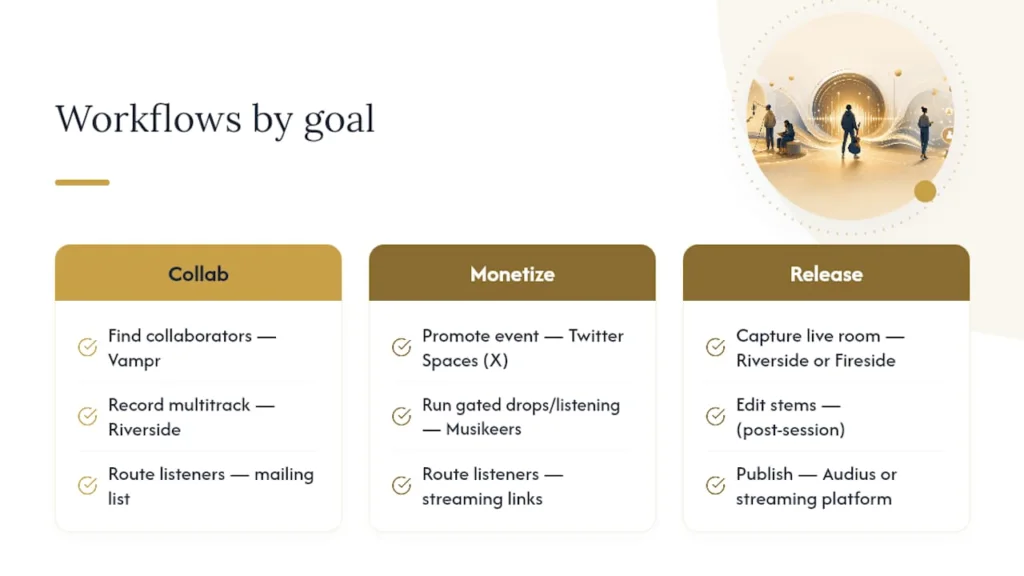
Fan monetization. Run listening parties and gated drops through Musikeers, and use Twitter Spaces (X Spaces) to promote the event to your existing followers beforehand.
Recording to release. Capture the live room on Riverside or Fireside, edit the stems, then publish through Audius or your streaming platform of choice.
Promotion and discovery. Route room listeners toward your mailing list or streaming links immediately. Our guide on turning social attention into a real music career covers this handoff in more depth.
What We’ve Learned Building Fans Through Social Audio
DRVVYN Sound has used listening parties and casual collaboration rooms to test new material before release, and the pattern holds: rooms create moments, but owned channels like a mailing list are where those moments turn into lasting fans. The lesson is simple. Treat every room as a funnel, not a final destination.
— DRVVYN Sound
When You’d Rather Hire the Work Out
Building your own audience room by room takes time most working musicians don’t have. Some musicians opt for original music production, cinematic visual content, and artist branding all handled by a team instead of piecing it together across a dozen apps. If you need a finished, licensing-ready release or a visual campaign built around your sound, that’s where done-for-you production beats DIY networking every time. Artists chasing raw discovery might still want a room on Clubhouse or Spaces, but if you want a master and a video ready to ship, hear what a finished release actually sounds like and see if it fits your next drop.
Sources
- The best social audio apps in 2026
- Vampr
- Musikeers® – Direct-to-Fan Platform for Independent Artists
- Audius — Free Music Streaming for Artists, Labels & Fans • Audius
FAQ
What Are Some Good Social Media Apps for Musicians?
Twitter Spaces (X Spaces), Facebook Live Audio Rooms, and Clubhouse work well for reaching fans, while Vampr is built specifically for finding collaborators.
What Apps Do Most Musicians Use?
Most independent musicians combine a discovery app like Clubhouse or X Spaces with a recording tool like Riverside and a direct-to-fan platform like Musikeers for monetization.
What Social Media Is Best for Musicians?
There’s no single best platform. X Spaces suits artists with an existing following, Facebook Live Audio Rooms suit artists with active group communities, and LinkedIn Audio Events suit those networking with industry professionals rather than fans.
What Are Some Popular Social Audio Apps?
Clubhouse, Twitter Spaces (X Spaces), Facebook Live Audio Rooms, Reddit Talk, LinkedIn Audio Events, and newer entrants like Riverside and Suno all rank among the most active social audio apps heading into 2026.