

Music Business
5 Step U.S. Workflow to License Music for Commercials
Practitioner focused U.S. workflow for licensing music in commercials. 5 clear steps to clear sync and master rights, a publisher checklist, and PRO guidance.
By DRVVYN · · 9 min read

Before a single frame airs, a commercial needs two separate clearances: a synchronization license for the composition and a master-use license for the actual recording, unless the rights are already owned or the music was created as a work for hire. Public-performance obligations through a performing rights organization may also apply once the ad runs on broadcast, streaming, or certain digital platforms. Every detail, territory, media, term, and exclusivity, needs to be confirmed in writing before the music touches a final cut.
TL;DR:
- Commercial licenses require separate sync and master-use clearances, negotiated directly with rights holders, as no compulsory licensing exists for audiovisual works.
- The cost of licensing varies widely based on song prominence, exclusivity, territory, media type, and duration, with fees ranging from modest to substantial depending on the track’s prominence and usage scope.
- Proper documentation, including signed licenses, cue sheets, and clear chain of title, is crucial; vague requests and poor record-keeping can cause campaign delays or legal issues.
- Using unlicensed or improperly cleared music exposes campaigns to significant legal liability, including statutory damages and potential removal of the advertisement.
- Clear communication of all media, territory, and term parameters upfront in a detailed usage worksheet speeds up the licensing process and reduces misunderstandings.
Which licenses and rights matter for a commercial
Music carries two distinct copyrights, and a commercial has to clear both. The synchronization license covers the composition, the melody and lyrics, and is granted by the publisher or songwriter. The master-use license covers the specific recording of that composition and is granted by the label or the artist who owns the master. The U.S. Copyright Office confirms there is no compulsory license for either synchronization or master use in audiovisual works, so advertisers must negotiate directly with rights holders rather than rely on a statutory rate.
Performing rights organizations like ASCAP, BMI, and SESAC handle a different piece entirely: public-performance royalties owed when the ad airs on television, radio, or in venues that hold blanket licenses. They don’t grant sync or master rights, but they track performances and collect royalties on the songwriter and publisher side.
- A sync license clears the composition for use with visual images.
- A master-use license clears the specific sound recording being synced.
- PRO licensing (ASCAP, BMI, SESAC) covers public performance once the spot airs.
- The mechanical compulsory license, common for cover songs on audio-only releases, does not extend to audiovisual synchronization, which is why sync and master deals stay voluntary and negotiated.
Step-by-step: how to license a track for an ad
Clearing a song for a commercial follows a repeatable sequence, even when the negotiation itself varies.
- Define the use precisely. Nail down every channel (broadcast, streaming, social, in-store), territory, term length, exclusivity needs, and deliverable format before you contact anyone.
- Identify the rights holders. Search publisher databases, check label metadata, and use PRO repertory lookups to find who administers the composition and who owns the master.
- Send a clear initial inquiry. State the project type, budget range if you have one, and the exact usage parameters from step one so the rights holder can quote accurately.
- Negotiate the terms. Fees, exclusivity, attribution requirements, revision rights, renewal options, and required deliverables (stems, final masters, metadata) all get settled here.
- Sign and execute. A written contract from every rights holder, a completed cue sheet, PRO registration where relevant, and archived paperwork close out the clearance.
Skipping the first step is the most common reason clearances stall. A publisher or label cannot quote a fair price without knowing whether the ad runs for six weeks on social media or for a year across national television.
What drives the cost of a sync or master license
Pricing for commercial music licensing has no fixed rate card, but a handful of variables consistently move the number. A song’s prominence in the spot (theme versus background), the exclusivity granted, the territory covered, the media type (digital, broadcast, or theatrical), the term length, and whether the placement is a hero moment or incidental all factor into the quote.
- Prominence matters: a song used as the emotional center of a campaign costs more than one played faintly in a background scene.
- Exclusivity raises price: a rights holder who agrees not to license the same track to a competing brand charges accordingly.
- Broader territory and longer term both push fees upward, since the rights holder is giving up more future flexibility.
- Media type changes the math: national broadcast and theatrical distribution typically command higher fees than a single digital placement.
Fee structures vary too. Some deals are flat buyouts, others are structured as per-air royalties, and some scale with ad spend or revenue share, particularly for larger campaigns or long-running brand partnerships. Costs can range widely, from modest fees for a stock library track to substantial sums for a well-known recording with cultural weight behind it.
Using unlicensed music isn’t a shortcut, it’s a liability. Courts can award statutory damages and attorneys’ fees per infringed work, and a campaign built on an uncleared track can be pulled entirely once a rights holder objects.
Where to find music for a commercial
Three main paths lead to usable music, and each carries its own tradeoffs.
- Royalty-free or stock libraries move fast and cost less upfront, but many restrict broadcast or theatrical rights, so confirm the license covers your actual media plan before you buy.
- Custom composition gives you full creative control and exclusivity, since the piece is written for your brand alone, though it takes longer and costs more than pulling something off a shelf.
- Direct licensing from an artist, label, or publisher works well when a known track fits the creative vision, but it means coordinating sync and master rights separately, sometimes with more than one party on each side.
Before committing to any source, ask providers directly about territory limits, term length, and any exclusions buried in the fine print. A needle-drop license model, a one-time sync purchase for a specific placement, works well for smaller productions that don’t need long-term exclusivity. For teams weighing library options against other routes, it helps to understand what limited-use libraries actually cover before assuming a track is cleared for your format.
Clearance checklist and legal pitfalls to avoid
A short checklist catches most of the problems that sink a commercial after the fact.
- Confirm both the sync and master rights are cleared, not just one.
- Verify chain of title: has the person quoting you actually confirmed they hold the rights they’re licensing?
- Check for uncleared samples or interpolations buried inside the track itself.
- Confirm territory, media, and term match your actual media plan, in writing.
- Get signed licenses and a completed cue sheet before the ad goes live.
Watch for red flags that should pause a purchase: ambiguous ownership claims, stock library terms that quietly exclude broadcast use, no written assignment for a master someone claims to control, or samples with no documented clearance trail. Corporate video formats often carry their own runtime and platform expectations, and it’s worth checking what those formats typically require before locking in license terms that don’t match the deliverable.
Pro Tip:Keep a searchable folder with every contract, cue sheet, ISRC, and metadata record tied to the campaign. It saves hours during a PRO audit or a rights dispute.
How DRVVYN Sound handles commercial licensing
Licensing inquiries often start with a usage worksheet outlining channels, territory, term, exclusivity needs, and delivery deadline. Straightforward library clearances can move quickly; custom compositions may take longer due to the creative process involved.
A clear paper trail protects the brand as much as it protects the artist.
Licenses typically include a signed agreement, a completed cue sheet, final masters, accurate metadata, and documentation of ownership rights. That documentation matters most after the campaign launches, when PRO reporting and royalty tracking depend on the metadata being right the first time.
What most licensing guides get wrong
Most guidance on this topic treats licensing as a paperwork problem: get the right forms signed, check the right boxes, move on. That misses the part that actually determines whether a campaign succeeds. The real risk isn’t the absence of a signature, it’s ambiguity buried inside a chain of title that nobody bothered to trace before the ad went live.
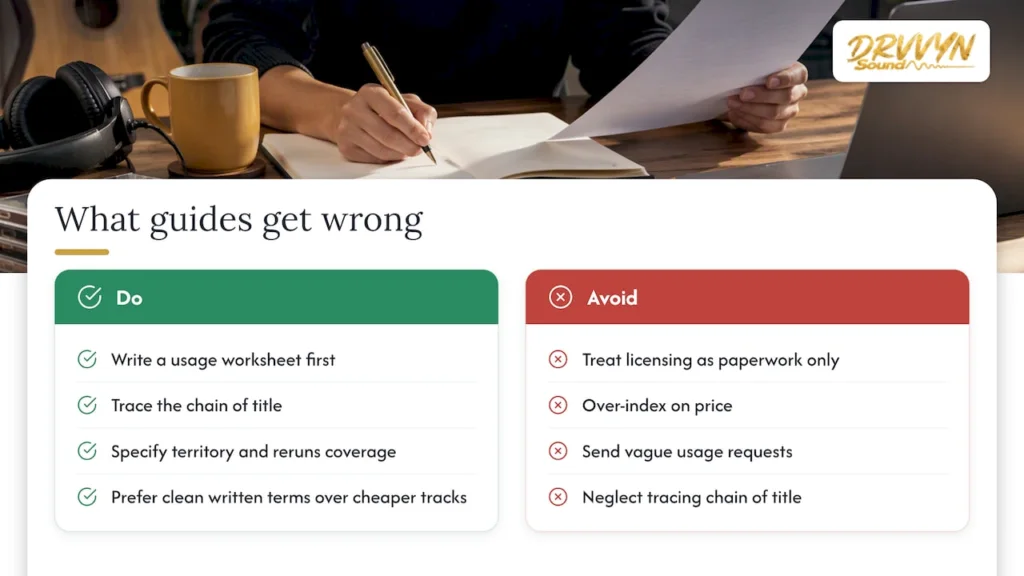
Teams tend to over-index on price and under-index on documentation. A cheap library track with murky broadcast restrictions costs more in the end than a slightly pricier license with clean, written terms. The guides that treat cost as the main variable are solving the wrong problem.
If there’s one thing worth prioritizing above all else, it’s the usage worksheet, written before any rights holder gets contacted. Vague requests produce vague quotes, and vague quotes produce campaigns that get pulled mid-run because nobody confirmed the territory covered digital reruns. Get specific first. Everything downstream, cost, timeline, risk, gets easier once that’s settled.
— DRVVYN Sound
Request a licensing quote from DRVVYN Sound
Once you know your media plan, getting cleared music doesn’t have to be a drawn-out back-and-forth. Services typically include licensing existing tracks and composing custom pieces, with deals finalized by signed agreements, cue sheets, final masters, and the metadata required for accurate PRO reporting.
To request a quote, send over a usage worksheet: channels, territory, term, exclusivity needs, and your deadline. That’s the fastest way to get an accurate number instead of a placeholder estimate. Visit the licensing page to start the conversation, or browse mood-driven tracks if you’re still shaping the creative direction for your campaign.
Sources
For legal definitions of sync and master rights, consult the U.S. Copyright Office’s guidance on musician income. For PRO licensing forms and public-performance rules, see ASCAP’s digital licensing page and its campaign licensing guidance.
This article is general information, not a substitute for advice from a qualified lawyer. Consult a qualified legal professional about your own circumstances before acting on anything here.
- U.S. Copyright Office: Report/Statement (sync/master rights guidance)
FAQ
Can I get a music license for commercial use?
Yes, but you need separate clearances for the composition and the recording unless you own both outright. The publisher or songwriter grants the sync license, and the label or artist grants the master-use license, and both are negotiated directly since neither has a compulsory rate.
How much does it cost to license music for a commercial?
Cost depends on prominence, exclusivity, territory, media type, and term length, so there’s no single number. Fees range from modest for background use of stock tracks to substantial for exclusive, prominent placement of well-known recordings, often structured as a flat buyout, a per-air royalty, or a share tied to ad spend.
Do you need permission to use a song in a commercial?
Yes. The Copyright Office confirms there’s no compulsory license covering audiovisual synchronization, so advertisers must negotiate directly with the composition’s publisher and the recording’s owner before the ad airs.
Where can I find copyright-free music for commercial use?
Royalty-free libraries and some Creative Commons catalogs offer tracks for commercial use, but every license has its own conditions. Check whether the specific Creative Commons license or library terms actually cover broadcast, theatrical, or long-term use before you build a campaign around the track.