
Artist Strategy
Build an Authentic Music Brand Archetype Musicians Use on Platforms
Choose an authentic music brand archetype and map it to visuals, sonic cues, and platform signals to earn saves, playlist adds, merch sales, and lasting fans.
By DRVVYN · · 15 min read
A music brand archetype is the recurring emotional pattern that shapes how an artist looks, sounds, and connects with listeners, and it exists whether you name it or not. Choosing one on purpose aligns your visuals, your production choices, and the way fans respond to you across every platform. Before you touch a mood board or a mix, run the short self-audit in the next section so the archetype you pick actually reflects who you are.
TL;DR:
- Choosing an archetype that authentically reflects your core values and lyrical themes is crucial for building a consistent emotional identity.
- Visual and sonic elements should reinforce your archetype through color palettes, instruments, tempos, and content, creating a layered persona that feels genuine.
- Testing and measuring engagement over several weeks helps determine if your archetype resonates, with visual authenticity strongly predicting fan loyalty.
- Avoid copying trends or selecting an archetype based solely on current success, as inauthentic branding risks collapse under pressure or unscripted moments.
- Evolving your archetype should be gradual and driven by genuine personal growth to maintain audience trust and long-term fan relationships.
The 12 archetypes and how they show up in music
Carl Jung’s original framework has been adapted by branding theorists into twelve recognizable patterns, and each one gives musicians a different emotional promise to keep. These are not costumes. They are the through-line that should already exist in your lyrics, your tone of voice, and the way you treat your fans.
- Innocent: Music that offers comfort and simplicity, often built on optimism and clean emotional resolution. Creative cue: soft, natural light in visuals and major-key melodic hooks.
- Explorer: Restless, searching artists whose work chases new territory, sonically or lyrically. Creative cue: location-based visuals and evolving sonic textures across a project.
- Sage: Artists positioned as truth-tellers or thoughtful observers of the world. Creative cue: spoken-word interludes and minimalist, text-forward cover art.
- Hero: Triumph-over-struggle narratives with driving, propulsive production. Creative cue: crescendo-based arrangements and training-montage-style visuals.
- Outlaw: Rule-breaking artists who reject convention in sound or image. Creative cue: distorted textures, raw mixing choices, and unpolished handheld video.
- Magician: Transformation and atmosphere-driven work that feels larger than life. Creative cue: reverb-heavy soundscapes and visual effects that bend reality.
- Regular person: Grounded, relatable artists who sound like a friend rather than a star. Creative cue: everyday settings and conversational lyric writing.
- Lover: Intimacy-focused artists built around sensory, emotionally rich songwriting. Creative cue: warm color grading and close, breathy vocal production.
- Jester: Playful artists who use humor and irreverence as their emotional hook. Creative cue: bright, saturated visuals and unexpected tempo shifts.
- Caregiver: Nurturing artists whose work centers on protection and emotional support. Creative cue: gentle dynamics and lyrics that speak directly to the listener’s pain.
- Creator: Genre-blending artists driven by originality and craft. Creative cue: visible production process content and layered, unconventional arrangements.
- Ruler: Confident, authoritative artists who project control and ambition. Creative cue: structured, symmetrical visuals and commanding vocal delivery.
Most artists lean toward two or three of these rather than fitting one perfectly, which is normal and something the next section will help you sort out.
How to identify your archetype without forcing it
The goal is to find the pattern that is already true about you, not to pick the one that looks best on a mood board this month. A short self-audit gets you there faster than months of guessing.
- List your core values in three words, then check which archetype’s emotional promise matches them naturally.
- Name your emotional center: the feeling you return to most often in your lyrics, whether that is longing, defiance, comfort, or curiosity.
- Track your recurring themes across your last five songs and look for a pattern rather than a one-off.
- Note your strongest fan reactions: which songs or posts get comments that use words like “healing,” “real,” or “unstoppable,” since fans often name your archetype before you do.
- Map yourself against artists you admire, not to copy them, but to see which emotional lane feels closest to your own instincts.
Score each candidate archetype on three factors: how authentic it feels against your actual life and lyrics, how well it fits the audience you already attract, and whether it supports the career direction you want in the next two years. The archetype that scores highest across all three, not just the one that feels trendy, is the one worth building around.
The biggest red flag is choosing an archetype because it is currently performing well for other artists rather than because it reflects something true about you. Visual authenticity is one of the strongest predictors of how fans respond and whether they stick around, according to a quantitative case study on aura framing, which found it outweighed most other engagement factors it tested. A forced archetype tends to collapse the first time you are asked to perform it under pressure, like a livestream Q&A or an unscripted interview.
Pro Tip:Write down your answers to the self-audit before you look at any archetype list, so your instincts shape the label instead of the other way around.
Turning your archetype into visuals, sound, and shows
An archetype only matters once it shows up in things fans can see and hear, with visuals that emphasize identity and culture as explored in Worn Graphics in Street Style: Identity, Culture, and Craft. Digital platform research on artist identity describes a layered persona model, real person, performance persona, and song-specific character, that lets artists stay authentic while still producing content that fits each platform’s format, as detailed in a Frontiers study on digital identity construction. That layering is the difference between an archetype that feels like a costume and one that feels lived-in.
- Cover art: Choose a color palette and typography style that repeats across every release so the archetype becomes visually recognizable within a glance, and pair it with music visualizer recipes built around the same mood.
- Sonic palette: Match instrumentation and tempo to the emotional promise, warm low-end and slower tempos for a Lover or Caregiver, sharper transients and faster tempos for a Hero or Outlaw.
- Content plan: Build a rotation of post types, behind-the-scenes clips, lyric breakdowns, and short performance snippets, that each reinforce the same emotional beat rather than feeling like unrelated content.
- Fan rituals: Give fans a repeatable action tied to your archetype, a comment prompt, a challenge, or a call-and-response moment at shows, so the archetype becomes something they participate in.
- Live shows: Let your stage presence, lighting choices, and setlist pacing echo the same emotional arc as your recordings instead of introducing a different persona live.
- Merch: Choose product types and packaging that extend the archetype physically, a Sage might sell letterpress lyric prints, while a Jester might lean into playful, limited-run items.
Sequencing matters here. A useful order is signature visual first, then a short-form video template that repeats that visual hook, then an audio release that mirrors the same sonic cue, a pattern that reinforces the same emotional claim across formats and tends to strengthen platform-level signals over time.
Archetype tactics you can copy from other artists
Archetype choices become useful once you can see them play out in specific creative decisions rather than abstract theory. A few patterns show up often enough to be worth borrowing directly.
- The layered persona approach: An artist who separates their real self, stage persona, and song-specific characters can post more personal, unpolished content on one channel while keeping a heightened visual identity for official releases, a structure supported by the identity research on platform-based persona layering.
- Craft-first branding in competitive genres: Research on personal branding in digital hip-hop found that technical mastery often has to come before branding can convert into real platform authority, since subcultural audiences and algorithms both reward visible skill; posting studio breakdowns or live takes can satisfy both, according to research on platform affordances and personal branding.
- Playlist-driven discovery: Independent artists who lean into platform playlist ecosystems can gain early visibility without a label, since curated placement systems are built to surface new music to receptive listeners, per Spotify’s Loud & Clear data.
- Merch tied to a visual signature: Artists who repeat one strong visual motif, a color, a symbol, a font, across merch and cover art make that motif recognizable enough that fans use it to identify the artist before hearing the music.
The common thread is that each tactic ties a creative decision to something measurable, a comment pattern, a playlist add, a merch sellout, rather than resting on a vague sense that the branding “feels right.”
How to tell if your archetype is actually working
An archetype is only useful if it changes fan behavior, so treat it as a hypothesis rather than a finished identity. Watch engagement rate, video completion rate, saves and playlist adds, and merch conversion as your primary signals, since these track whether people are absorbing and acting on your identity rather than scrolling past it.
- Run a visual A/B test on cover art using two palettes that both fit your archetype, then compare click-through and save rates.
- Release a sonic micro-variant, an alternate mix or arrangement of an existing song, to see which version holds attention longer.
- Test a fan-facing call to action, a comment prompt or challenge, and track whether it produces the kind of response your archetype should generate.
Give each test two to four weeks before drawing conclusions, since short-form platforms can take time to fully distribute a post. Visual authenticity is the strongest predictor of fan behavioral intentions and engagement, according to the aura framing case study, which means a weak-performing visual test often points to a mismatch between your archetype and your actual presentation rather than a bad platform day. If two consecutive tests fail to move engagement, revisit the self-audit before changing your entire strategy.
A practical checklist for putting an archetype into production
A workable archetype rollout tends to follow the same six steps regardless of genre: audit your values and themes, choose the archetype that scores highest for authenticity and fit, write a short creative brief translating it into visual and sonic language, produce the assets, release them in the sequence described earlier, then measure and adjust.
- Audit and choose: Confirm the archetype against lyrics, values, and existing fan language before committing.
- Creative brief: Translate the archetype into a one-page reference covering color, typography, tempo, and content tone.
- Cinematic visual assets: DRVVYN Sound produces visualizers and music videos built around a defined mood, which map directly to the visual step of this workflow.
- Branding sessions: Structured conversations that help pin down the emotional core before any asset gets produced.
- Licensing-ready masters: Mixes and masters prepared for sync and licensing use once the sonic palette is locked in.
- Release and iterate: Track the metrics above and revisit the brief every few releases rather than treating it as fixed forever.
Where brand archetypes in music actually come from
The archetype framework used in music branding today traces back to Carl Jung’s theory of universal psychological patterns, later adapted for commercial branding by strategists Margaret Mark and Carol Pearson. Their argument was that durable brands succeed not by inventing a personality but by aligning with a pattern that already exists in the human psyche, one that audiences recognize instinctively because it echoes myth, story, and shared cultural memory.
That framework moved into consumer branding decades before musicians adopted it deliberately, but musicians had been building archetypal identities long before anyone gave the practice a name. A defiant performer with a leather jacket and raw guitar tone was working the Outlaw pattern instinctively, just as a soft-spoken singer-songwriter with acoustic instrumentation was living the Innocent or Caregiver pattern without ever naming it.
What changed with digital platforms is the speed and precision with which that pattern now has to show up. A record label once had months to build a visual identity around an artist through print media and television. Today, a fan forms an impression within seconds of a short-form video, which means the archetype has to be legible almost instantly rather than revealed slowly over a career. The theory did not change, but the timeline for expressing it collapsed, and that collapse is exactly why intentional archetype work matters more now than it did when the framework was first written.
Why archetypes resonate with listeners on a psychological level
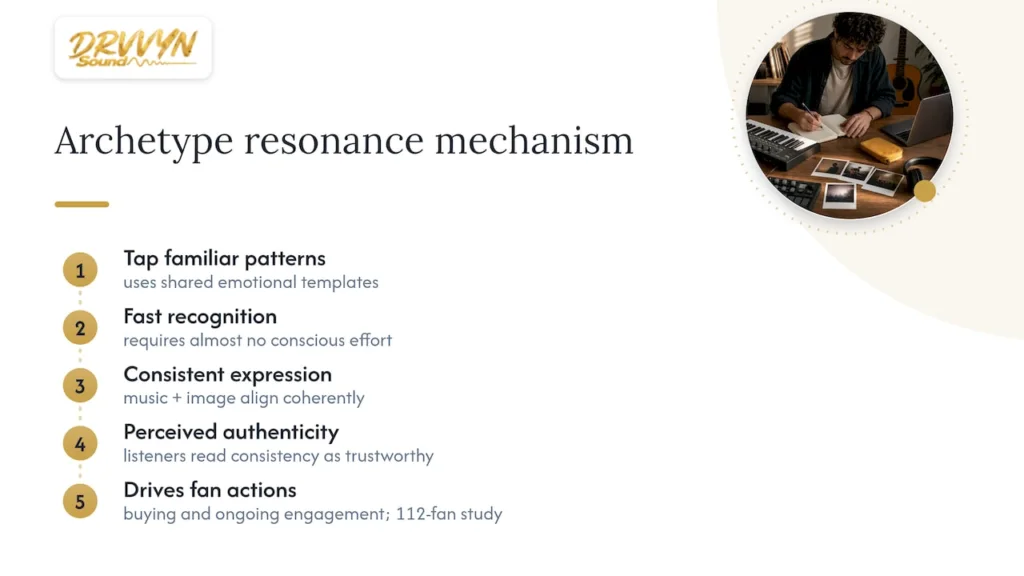
Archetypes work because they tap into emotional patterns people already recognize, rather than asking a listener to learn something new about an artist from scratch. A Jung-based framework holds that certain patterns, the caregiver, the rebel, the seeker, are embedded deeply enough in shared human experience that recognizing them takes almost no conscious effort. When an artist’s music and image consistently express one of these patterns, listeners process the identity as coherent and trustworthy rather than scattered.
This is part of why visual authenticity carries so much weight in fan response. The aura framing case study found that authenticity signals predicted fan behavioral intentions, including willingness to buy and to stay engaged over time, more strongly than most other factors it measured, based on survey and engagement data from 112 fans. Listeners are not consciously grading you against a checklist of archetype traits. They are responding to whether your presentation feels internally consistent, and inconsistency reads as inauthenticity even when a listener cannot articulate why.
The emotional payoff for the listener also matters. A Hero’s music promises a version of overcoming struggle that a listener can borrow for their own life. A Lover’s music offers permission to sit inside intimacy or longing without judgment. That transaction, an artist supplying an emotional pattern the listener needs, is the real mechanism behind archetype resonance, and it explains why the same archetype can work across wildly different genres and eras.
Combining and evolving archetypes without losing coherence
Few artists fit one archetype cleanly for an entire career, and trying to force that can flatten what makes an artist interesting. A more realistic approach treats one archetype as a primary anchor and a second as a supporting note, an Outlaw-Lover combination reads as raw intimacy, while a Sage-Creator combination reads as thoughtful genre experimentation. The anchor archetype should govern the emotional core of your lyrics and public voice, while the supporting archetype shows up in specific formats, maybe your live shows lean Hero even if your recordings lean Caregiver.
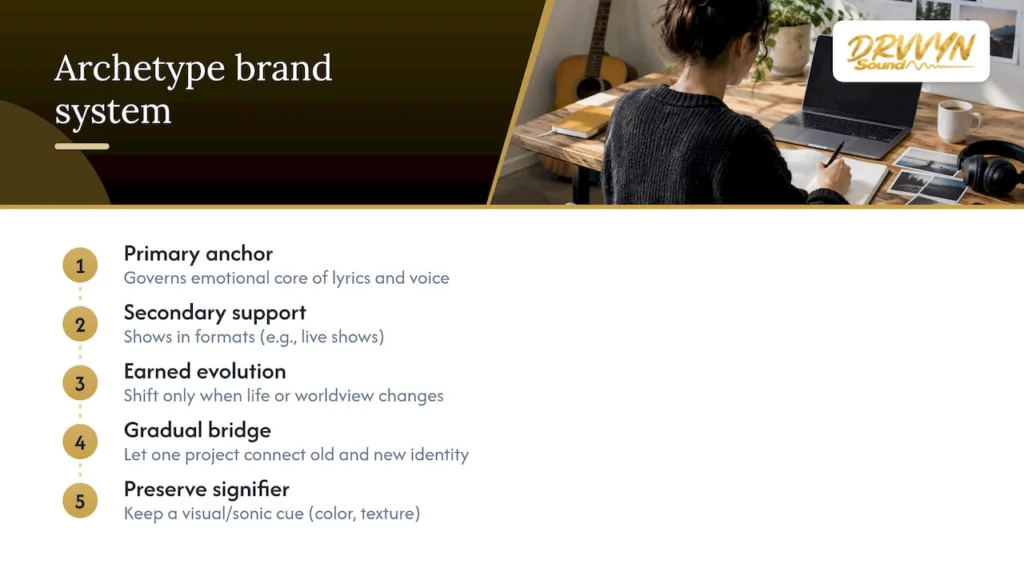
Evolution over time is different from combination and should be handled carefully. An archetype shift works best when it tracks a real change in the artist’s life or worldview rather than a reaction to a trend cycle or a slump in numbers. Listeners tend to forgive evolution that feels earned, a Jester moving toward Sage after a period of public reflection, for instance, but they notice when a shift looks purely tactical.
The safest way to evolve is gradually, letting one project bridge the old and new identity rather than making an abrupt reset. Keep whatever visual or sonic signifier fans already associate with you, a certain color, a vocal texture, and let that anchor carry through the transition while everything else shifts underneath it. That continuity is often what keeps a fan base intact through a rebrand instead of confused by it.
Mistakes that undermine archetype work in music branding
The most common mistake is choosing an archetype based on what appears to be working for other artists rather than what is actually true about your own values and themes. This produces content that looks right on paper but collapses under scrutiny, especially in unscripted moments like interviews or livestreams where a performed identity is harder to sustain.
A second mistake is treating the archetype as a visual filter without matching it sonically. An artist can nail a Magician’s color grading and typography while still producing production choices that sound closer to Regular Person, and the mismatch confuses listeners even when they cannot name what feels off.
A third mistake is skipping the platform-fit question entirely. Research on personal branding and platform affordances found that in competitive genres, technical mastery often has to be visible before branding can translate into real authority, according to research on digital hip-hop branding, which means an archetype built entirely on aesthetics without demonstrated craft can stall out regardless of how polished it looks.
A final mistake is abandoning an archetype too early after a single underwhelming release, or clinging to one too long after it has clearly stopped resonating. Both errors come from skipping the measurement step: without clear metrics, it is easy to mistake a bad release week for a broken archetype, or a lucky viral moment for permanent traction.
Why archetype-first branding builds fan relationships that last
Archetype work only pays off when it is honest, and honesty is what platforms and fans both reward over time. Visual authenticity consistently outpredicts polish, which means the artists who last are usually the ones willing to let an imperfect but true identity carry more weight than a flawless but borrowed one. Try changing one small, visible thing this week, a color choice, a caption tone, and watch what happens.
— DRVVYN Sound
How DRVVYN Sound helps artists bring an archetype to life
Once you know your archetype, the harder part is often turning it into polished, release-ready work without losing the emotional thread along the way. DRVVYN Sound builds cinematic visual content, mood-driven original music, and licensing-ready masters for artists who want their branding to feel considered rather than assembled in a rush, and offers licensing and artist development services for those ready to take the next step. Reach out through the profile page to talk through where your identity currently stands and what a realistic next release might look like.
Sources
- Digital platforms and the identity construction of Billie Eilish: exploring self-expression in the music industry
- Aura framing and fan behavioral intentions: a quantitative case study
- Takeaways – Loud and Clear
- Platform affordances, personal branding and gendered agency in Indonesian female digital hip-hop
FAQ
What are the 12 brand archetypes?
The 12 brand archetypes are Innocent, Explorer, Sage, Hero, Outlaw, Magician, Regular Person, Lover, Jester, Caregiver, Creator, and Ruler. Each represents a distinct emotional pattern that shapes how an audience perceives a brand or an artist’s identity.
What are the 12 character archetypes for musicians?
Musicians use the same 12 archetypes from general branding theory, adapted to musical context: each one guides lyrical themes, visual choices, and sonic decisions rather than describing a fixed personality type. An artist’s fit usually shows up first in recurring lyrical themes and the emotional reactions their music already generates.
What are the 12 types of archetypes?
The 12 types, drawn from Jungian-based branding theory, are Innocent, Explorer, Sage, Hero, Outlaw, Magician, Regular Person, Lover, Jester, Caregiver, Creator, and Ruler. They are used across branding, storytelling, and music to describe recurring emotional patterns audiences recognize instinctively.
What are the 12 brand personality archetypes?
Brand personality archetypes are the same 12 categories used in consumer branding theory: Innocent, Explorer, Sage, Hero, Outlaw, Magician, Regular Person, Lover, Jester, Caregiver, Creator, and Ruler. In music, these personality patterns translate into visual style, sonic choices, and the tone an artist uses when speaking directly to fans.
How do I know if my chosen archetype is working?
Track engagement rate, video completion rate, saves, playlist adds, and merch conversion over a period of two to four weeks after a change. If those numbers do not move after two consecutive tests, the mismatch is usually between the archetype and your actual presentation, not the platform itself.