

Creative Process
12 Songs for Late Night Journaling Sessions
Songs for late night journaling can make room for better writing. Build a quiet, repeatable listening practice that supports your next song without distraction.
By DRVVYN · · 7 min read
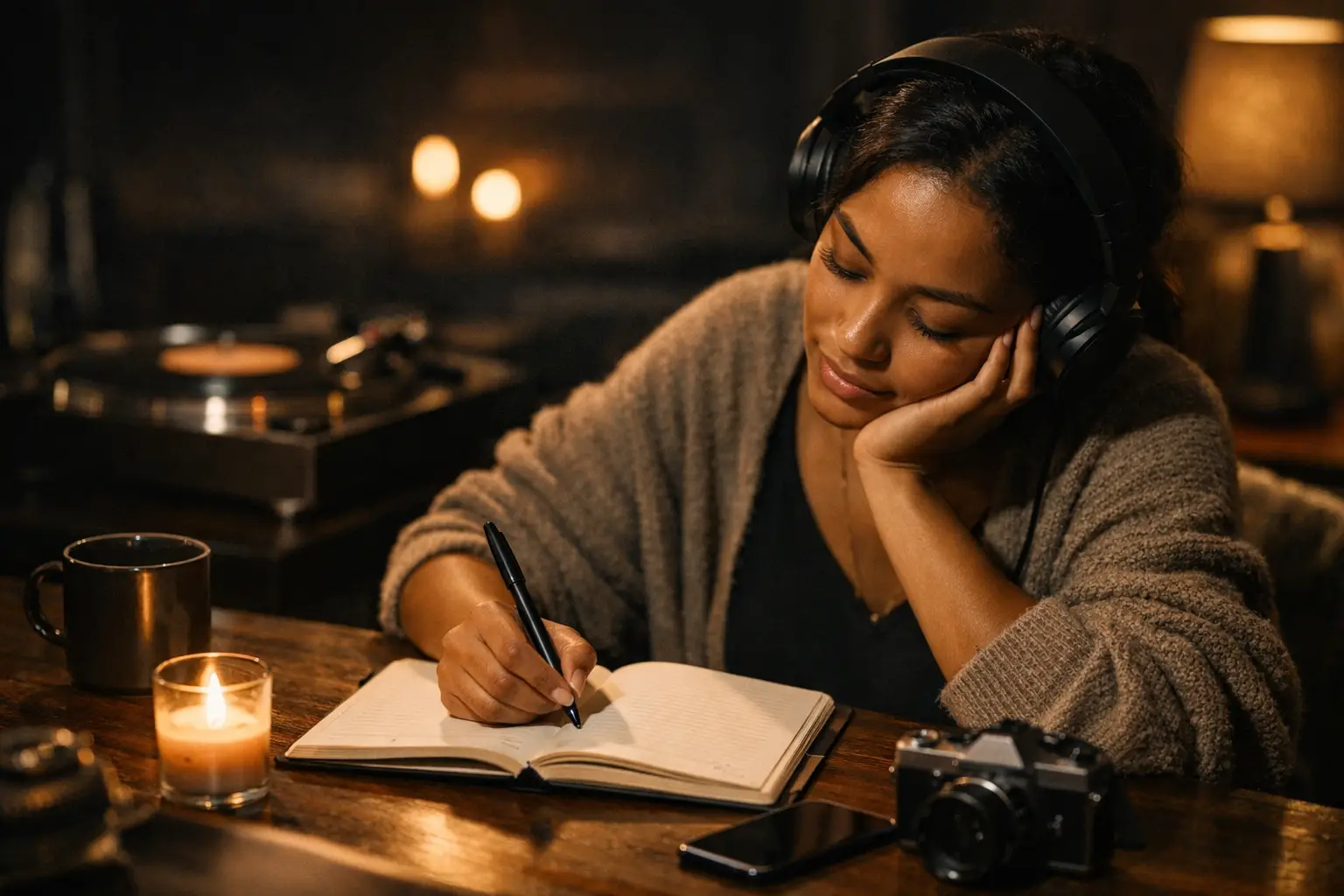
The best songs for late night journaling do not tell you what to feel. They leave a little space in the room.
For an independent artist, that space is useful. A journal can hold the line you are not ready to sing yet, the visual world around a release, the honest reason a song needs to exist. The right music can help you stay with an idea long enough to find it.
This is not a playlist built for background noise. It is a small listening practice for writers, producers, and artists who need a quieter way back into their own work.
Songs for Late Night Journaling That Leave Room
Start with tracks that have atmosphere, movement, and restraint. Lyrics are not the enemy, but they can pull your language toward someone else’s. On nights when you need to write freely, instrumental or lightly vocal music usually gives you more room.
Here are 12 songs to return to. Do not treat them as a fixed sequence. Let the first track match the room you are actually in.
- Brian Eno – An Ending (Ascent). Weightless and patient. Good for beginning before you know what you are trying to say.
- Nils Frahm – Says. A steady build without a rushed destination. Useful when your thoughts arrive in fragments.
- Ólafur Arnalds – Near Light. Quiet piano and texture for pages that need less performance and more observation.
- Khruangbin – Friday Morning. Warm, unhurried, and slightly sun-faded. A good choice when late night writing needs softness instead of heaviness.
- The xx – Intro. Spare and cinematic. Put it on when you need to define the mood of a visual, a song, or a new era.
- Sade – No Ordinary Love. The lyrics are present, but the track moves slowly enough to invite reflection. Best for writing around a feeling rather than trying to escape one.
- James Blake – Retrograde. Tense, spacious, and emotionally direct. Use it when the page needs a little more voltage.
- Frank Ocean – Seigfried. A song for unfinished questions. Keep it for nights when your journal is less about answers and more about staying honest.
- Mitski – Two Slow Dancers. Brief, vivid, and exposed. A reminder that a small scene can carry a large emotional truth.
- Bon Iver – Holocene. Good for perspective. The arrangement feels wide, while the writing stays personal.
- Cigarettes After Sex – Apocalypse. Soft-focus and nocturnal. It works well for visual notes, memories, and phrases that belong to a slower record.
- Massive Attack – Teardrop. Darker and more rhythmic. Useful when you are journaling toward a beat, a title, or a concept with tension underneath it.
These choices are not rules. If a song pulls you out of your own voice, skip it. If an old favorite opens a door, keep it. The point is not to curate the perfect late-night aesthetic. The point is to notice what helps you make something true.
Build a Journaling Session Around the Work
A journal session can be as short as one song. The value is in returning, not in forcing a breakthrough.
Before pressing play, decide what kind of page you need. There is a difference between documenting your day and gathering material for your next release. Both matter. They just ask different questions.
For personal writing, begin with a plain sentence: What is still following me from today? Do not improve it. Do not turn it into a lyric too soon. Write the detail exactly as it happened: the light in the room, the message you did not send, the drive home, the thing you almost said.
For songwriting, write from one image instead of one emotion. “I feel lost” may be real, but it is not yet a scene. “I missed the last train and watched the platform empty” gives you somewhere to stand. Songs tend to become more specific when the journal does.
For release planning, let the music set the tone, then write a page about the world around the project. What time does this record belong to? What colors show up? What does the listener see before the first line starts? What should a fan understand about the work without needing a long explanation?
That page may never become public. It still has value. Clear internal language makes the public-facing work easier later: the cover art direction, short-form visual ideas, stage mood, press copy, and the way you describe the release to people who are meeting your music for the first time.
Keep the First Draft Private
Artists are often trained to turn every thought into content. That pressure can flatten the early stages of a song.
Your journal is allowed to be unpolished. It can be contradictory. It can include bad lines, loose references, names you will remove, and ideas that never become a track. Privacy is not wasted effort. It is where stronger public work often begins.
Try separating each session into two parts. First, write without editing for the length of one or two songs. Then stop and underline only what still feels alive. Not what sounds impressive. Not what would make a good caption. What feels like it has a pulse.
Those underlined fragments can go into a working note for your music. A title. A phrase. A production cue. A short description of the vocal delivery. Keep the original journal entry intact and copy only the piece you want to develop.
That small separation protects the source. It also keeps you from overworking a thought before it has found its shape.
Choose Music Based on the Page You Need
There is a tradeoff in every late-night listening choice. Ambient music can keep your mind open, but it may leave you drifting if you need momentum. A song with strong lyrics can bring emotional clarity, but it can also make you borrow its phrasing. Beat-driven music can help you write in rhythm, though it may push you toward performance before you have found the idea.
Match the sound to the job.
If you are stuck at the beginning, choose something minimal. If you are collecting lyric fragments, choose music with a clear emotional temperature but fewer words. If you are working through a song concept, use one track that shares its pacing or atmosphere, then turn it off and write in silence for a few minutes.
Silence belongs in the practice too. The song gets you to the door. You still have to walk into the room alone.
Turn Journal Notes Into an Artist Asset
Not every journal entry should become a release strategy. But a consistent practice can quietly improve the material around your music.
Over time, look for repeats. Maybe your pages keep returning to parking lots, blue screens, empty kitchens, long drives, or a particular kind of distance. Those patterns are not a brand exercise. They may simply be the visual and emotional language already present in your work.
When a project begins to take shape, review those notes before you write your artist statement or plan content. You may find a more honest center than the usual list of genre references. A listener does not need every detail, but they can feel when the release has a real point of view.
This is part of building an artist presence you control. Your website, release pages, emails, visuals, and songs should not feel like disconnected tasks completed for a platform. They can come from the same body of work. The upcoming Artist DRVVYN Engine, or ADE, is being built around that larger need: fewer disconnected systems, more ownership over the artist home and the relationship around the music.
For now, keep it simple. Make a folder for journal fragments. Date each note. Save the lines that stay with you after the music ends.
Some nights, the most useful thing you will write is not a chorus. It may be one clear sentence that tells you where the next song needs to go.